AT&T Pebble Beach Pro Am Course Preview

There are golf courses that test you, and then there are golf courses that expose you. Pebble Beach Golf Links does both with the Pacific Ocean as a backdrop and a scorecard that looks manageable until you actually try to survive it. Set on the Monterey Peninsula in California, Pebble Beach is not overwhelmingly long by modern professional standards. In standard PGA Tour setups for the AT&T Pebble Beach Pro-Am, it typically plays as a par 72 at just under 7,000 yards. U.S. Open setups have stretched it past 7,000 and sometimes reconfigured par, but in most modern Tour editions it’s short enough that players can attack — at least on paper.
That’s the illusion.
Pebble’s defense isn’t length. It’s angles. It’s wind. It’s tiny, sloping greens covered in Poa annua that can feel smooth in the morning and unpredictable by late afternoon. It’s cliff lines that wait patiently for a slightly over-aggressive swing. And it’s a finishing stretch that has decided more tournaments than almost any closing sequence in golf.
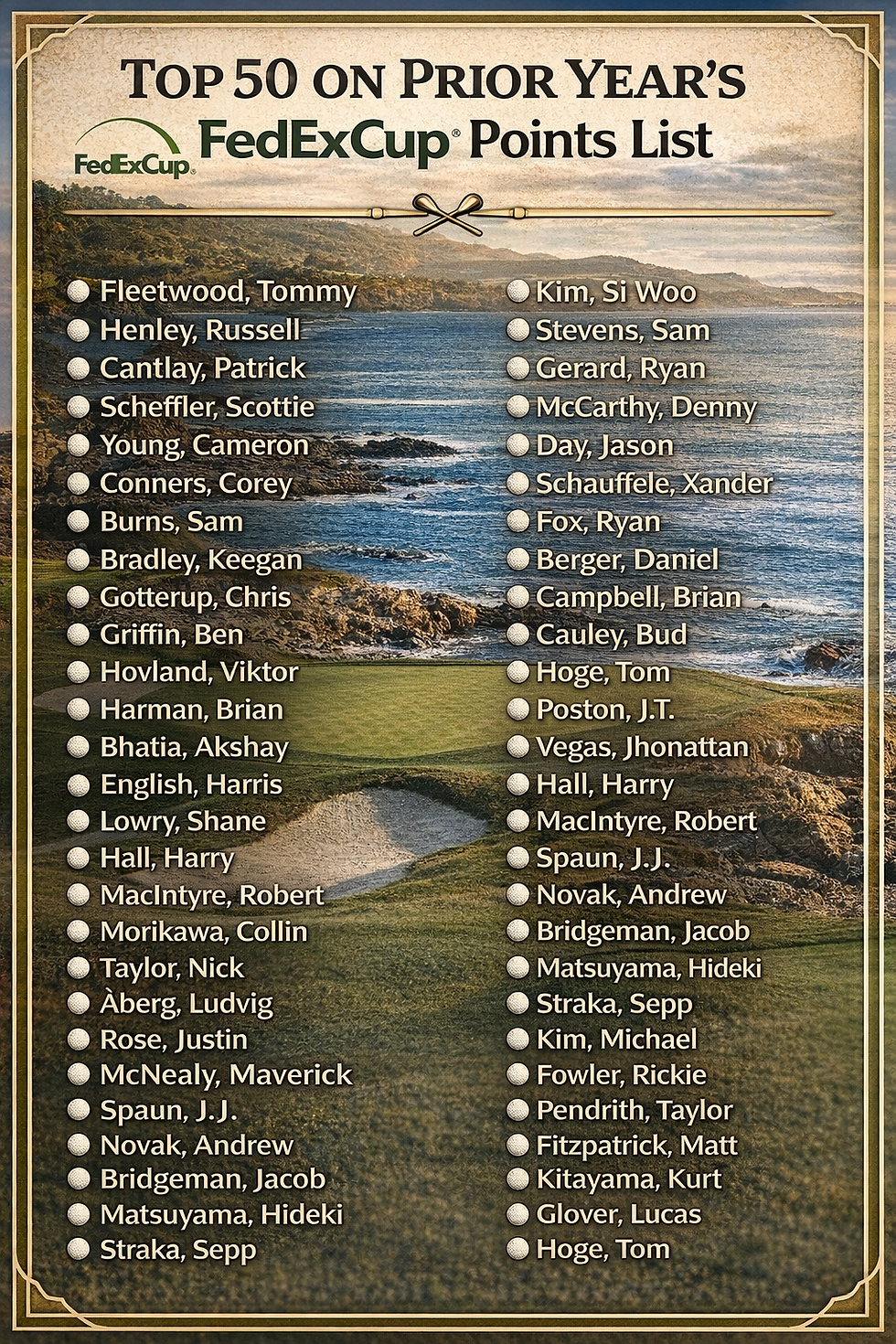
Past Winners:
The course was originally designed in 1919 by Jack Neville and Douglas Grant. Over the decades it’s been refined and restored, but its soul remains intact: strategic, exposed, and brutally honest. The routing flows inland early before crashing into the coastline at the par-3 7th and then dancing along the ocean through the 10th and again at the iconic 18th.
The 7th hole might be the most famous short par-3 in the world. It can measure barely over 100 yards in some setups. It sounds simple. It isn’t. The green is tiny, perched on a bluff, and completely exposed. Wind direction changes everything. One day it’s a comfortable wedge; the next it’s a flighted 8-iron into a crosswind. Miss in the wrong spot and par becomes work.
The 8th is the opposite: long, demanding, and framed by ocean. The tee shot is about position — favoring the proper side of the fairway to open the angle. The second shot plays uphill toward a narrow green with the Pacific staring at you from the left. It’s one of the purest “commit or pay the price” approach shots in championship golf.
And then there’s 18...........
The finishing hole runs along Carmel Bay, with the ocean hugging the entire left side. It’s reachable in two for the longest players when conditions allow, but the smarter play often wins here. Tee shot placement matters. Second shots flirt with disaster. And the green complex punishes indecision. More than a few tournaments have been decided by whether a player chose courage or caution on that hole.
So how do you win here? History tells a clear story. You don’t overpower Pebble. You control it.
Recent champions at the AT&T Pro-Am illustrate the formula. Rory McIlroy won here by pairing aggressive iron play with patience and excellent putting on Poa. Wyndham Clark relied on elite ball-striking and avoided big mistakes. Justin Rose and Tom Hoge each leaned heavily on precision approaches and timely scrambling.
The common threads are consistent:
First, iron play. Pebble’s greens are small by Tour standards. If you’re not hitting a high percentage of greens in regulation, you’re scrambling constantly — and scrambling on Poa with coastal wind isn’t sustainable over four rounds.
Second, discipline off the tee. Distance helps, but angles matter more. Many holes reward placement to a specific side of the fairway. The players who accept that a 3-wood or long iron is sometimes smarter than driver gain strokes without ever looking flashy.
Third, putting on Poa annua. This grass grows through the day. It can get bumpy late. Players who control pace — especially on lag putts consistently separate themselves. Pebble is not about making every 20-footer. It’s about never three-putting.
Fourth, wind management. The Monterey Peninsula rarely stays still. Even on calm mornings, a sea breeze typically develops by afternoon. Club selection becomes dynamic. Flight control becomes critical. The players who fight the wind lose; the players who shape shots into it thrive.
Short game rounds out the equation. When winds rise or pins tuck near edges, getting up-and-down becomes essential. Pebble champions rarely make double bogey. They accept pars when necessary and capitalize when the course offers opportunity, especially on the par-5s.
Weather is always part of the equation here. Typical tournament weeks bring coastal temperatures in the mid-50s to low-60s. Mornings can be cool and calm, with increasing onshore winds in the afternoon. If a system rolls in — which is common during winter Tour stops — rain can soften the course, making it shorter but placing a premium on spin control and wedge proximity. Wet Poa greens can slow dramatically, changing the feel of the entire course from Thursday to Sunday.
When conditions are firm and dry, Pebble plays faster and subtly longer. Tee shots release. Greens repel slightly more. Low-trajectory players who keep the ball under the wind can attack.
When it’s soft and damp, the course becomes more receptive. Approach shots hold. Par-5s become true scoring holes. But wind in those conditions can make even short irons uncomfortable.
Over time, Pebble has proven something simple but profound: it identifies complete players.
You need precision. You need creativity. You need patience. You need nerve standing on 18 with the Pacific roaring beside you. It’s not the longest course on Tour. It’s not the narrowest. But it might be the most psychologically demanding, because every shot is framed by consequence.And that’s why it keeps producing champions who look in control rather than overwhelmed. Pebble Beach doesn’t reward recklessness.
It rewards mastery.
Weather Forecast:



Comments